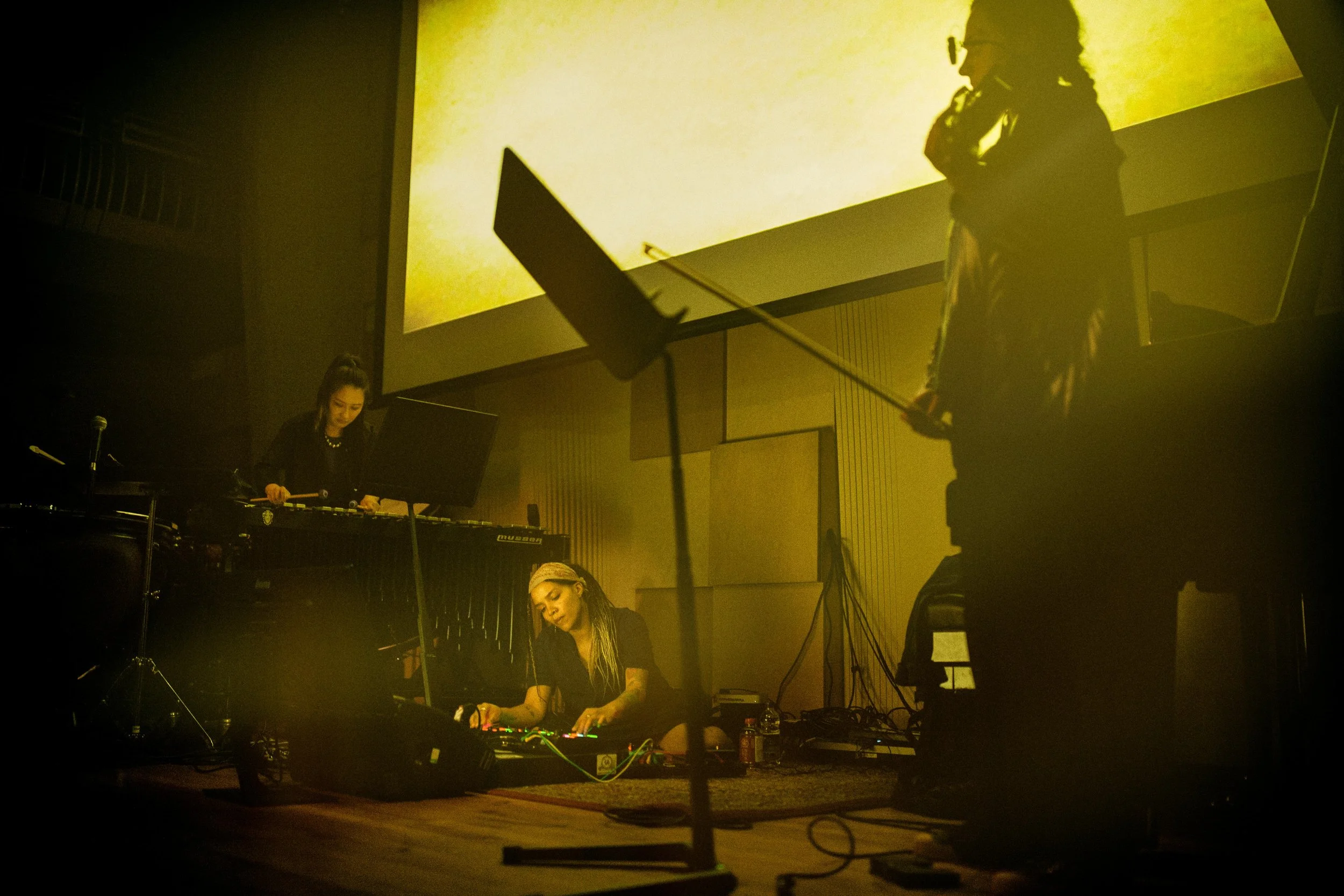
A testing ground for music creators who want to experiment within contemporary classical.
The possibilities of classical music are endless. It’s a living, breathing artform that reflects our contemporary world, as well as rooting us to the past. But access to instruments, education, networks and resources is often blocked by social and economic barriers.
EXPERIMENTA is for music creators who may have encountered these obstacles to the classical music space. It exists to amplify underrepresented voices by providing room for artistic risk-taking and creative play. Through this scheme, we seek to open up this world and make it more welcoming to a broader range of people.
EXPERIMENTA 2026 is now open for applications until Sunday 15 February, 11.59pm.
Supported by the PRS Foundation Talent Development Network and Granada Foundation
EXPERIMENTA 2026
EXPERIMENTA is open to Northern music creators who may have encountered barriers to entering classical music. It’s a nurturing space to try out new ideas and approaches to devising work, through collaboration with Manchester Collective’s musicians and team. Your work may sit within a different genre or defy categorisation altogether. What you need is musical curiosity, a real commitment to your practice and the courage to take risks.
The programme runs from February to July 2026. Expand the sections below to find out more and see if it’s right for you. You can also download a print-friendly version of this page containing all the information in one place. Applications close Sunday 15 February, 11.59pm.
If you have any questions, we’re here to help. Get in touch with our senior producer Jonas Roberts at jonas@manchestercollective.co.uk.
-
We believe music has the power to deeply move and excite us.
At Manchester Collective, we are known for adventurous programming of live classical music spanning centuries, daring collaborations with forward-thinking artists across genres and artforms, and transformative live experiences that dissolve the barrier between performer and audience.
The Collective is not a set of fixed musicians and creators, but something more fluid. We collaborate with electronic and sound artists, theatre companies, filmmakers, jazz and folk musicians. Our extended creative team includes storytellers and creative producers, photographers and fundraisers.
To us, reshaping the future of contemporary and classical music means staying curious, taking risks and breaking away from predefined categories.
You can read more about Manchester Collective and dive into our YouTube video channel.
-
Over the course of this programme, we’ll provide you with the guidance and resources to take your music practice to the next level and explore new possibilities.
This isn’t one-size-fits-all. We’ll tailor parts of the experience to the cohort of artists we work with, taking your individual practice and needs into account. However, all participants can expect:
A bursary of £1,125 with extra support available for travel, accommodation and access needs
Access to our musicians – singer and composer Héloïse Werner and percussionist Beibei Wang – to devise and perform new work
A two-day residency in Manchester, led by Héloïse and Beibei, which focuses on creative experimentation, sharing practices and exploring conceptual starting points for new work
Workshops and mentoring led by Héloïse and composer Jasmin Kent Rodgman, including an in-person group session and online 1-2-1s
A live sharing event in summer 2025 profiling your work, whether it’s in progress or complete
An invitation to attend rehearsals for our 25/26 season shows
The opportunity to spend time with other forward-thinking creatives in a supportive environment where everyone can learn from each other
There is no expectation of completed work at the end of the project, but we do expect you to use time outside of sessions to develop your ideas using tools and approaches you’ve learned.
-
EXPERIMENTA 2026 is open to music creators who:
create original music, either for yourself or others to perform
are based in the north of England OR are from the north of England and based elsewhere in the UK. The north of England includes: Cheshire, Cumbria, County Durham, Greater Manchester, Lancashire, Merseyside, Northumberland, Tyne and Wear, Yorkshire
have experienced barriers to entering the classical music sector. This could be due to disability, neurodivergence, socioeconomic disadvantage, being a woman (including trans women), non-binary, trans, global majority, and/or LGBTQ+
have not completed conservatoire training or studied classical composition at university level
are not currently in full-time education
are aged over 18
In 2025, we had many more suitable applicants than spaces. If you applied last year and meet this year’s eligibility criteria, don’t be discouraged from applying again.
-
EXPERIMENTA runs from March 2026 until July 2026. If you’d like to take part, we expect you to be available on the following dates, where specified:
Applications open: 19 January 2026–15 February 2026
Application outcome: no later than 20 February 2026
Introductory meeting and workshop (online): 26 February 2026, 6–7pm
Manchester residency at Low Four Studio: 2–3 March 2026
Composition workshop at Low Four Studio: 14 April 2026
1-2-1 mentoring sessions (online): May–July 2026
Second workshop with performers at Low Four Studio: 17 June 2026
Rehearsals and live sharing event at The White Hotel: 22–23 July 2026
-
To be considered for EXPERIMENTA, you need to submit an application form no later than Sunday 15 February, 11:59pm.
If you have any questions about the application process, or the programme as a whole and whether it’s right for you, please get in touch with our dedicated project manager Jonas Roberts on jonas@manchestercollective.co.uk.
The application form will ask you for some details about yourself, along with the questions below. This can be filled in using written, audio or video answers. You can save your answers and come back to them or, even after you’ve submitted, edit them up to the deadline. Please keep your written answers up to around 200 words per question or audio/video files no longer than five minutes in total.
There are prompts on the application form to help you think of what you could write for each question. These aren't mandatory points to cover – we want to hear what's important to you.
Tell us about yourself and your creative music practice.
What’s your relationship with contemporary classical music? What about it excites you?
Why do you want to take part in EXPERIMENTA? How will it help you develop creatively and professionally?
Has anything held you back from accessing opportunities in contemporary classical music before?
We’ll ask you for links to up to three examples of your work (public or private). We’d like these to be as recent as possible – we want to hear where you're at now. Don’t worry if they’re unreleased or works-in-progress.
Finally, you’ll be asked to complete some demographic questions about you and your identity. This will be used to ensure the selected cohort fulfils the aims of the project in equalising opportunity for underrepresented creatives in the contemporary classical music sector.
You’re welcome to use help from a personal assistant (PA), carer or friend in filling in the application form. We won’t be judging your submission based on the style of writing, spelling or grammar – bullet points are fine! Complete the application in whatever way is going to help best express who you are, your creative practice, and how this programme will support your journey.
-
After the deadline, your application will be assessed by a panel consisting of Manchester Collective’s co-artistic director Jasmin Kent Rodgman, senior producer Jonas Roberts, cellist Peggy Nolan and freelance project producer/artist manager Kinaya Said Ibrahim.
Shortlisted candidates will be contacted via email in the first instance. We’ll aim to let all applicants know the outcome no later than 20 February 2026.
Unfortunately, due to the expected application volume, we’re unable to provide individual feedback to all applicants.
-
Please reach out if you have specific access needs relating to the application process or any part of the programme. You can contact our dedicated project manager Jonas Roberts on jonas@manchestercollective.co.uk with your questions or to arrange a call.
In terms of specific financial support, we’re able to provide:
A contribution towards childcare costs for the in-person residency and workshop days (three in total) and the live showcase event
Accessible travel and accommodation, where needed
A contribution towards Personal Assistant (PA) costs, including their travel and accommodation
We can also discuss space for prayer, breastfeeding, quiet time, wheelchair access, or anything else you might require
Successful applicants will be invited to provide an access rider outlining preferences in communication methods, travel, accommodation and to share any other access needs. We have a template for this or you can provide your own. We’re also able to book in 1-2-1 conversations to discuss requirements or potential alterations any further.
In-person sessions will be held at Low Four Studio located at Deansgate Mews, Greater Northern Warehouse, Manchester, M3 4EN.
Low Four Studio has level access through a public lift from Deansgate or within Great Northern Warehouse
The main space is across a single floor
Green room, kitchen and toilets are down 20 stairs (81cm max access width, 26cm treads, 20cm uppers) from main space, or through step-free access via an access corridor (73cm door width) on Deansgate Mews
The nearest accessible toilet is opposite Low Four, in the ODEON cinema
The nearest train station and tram stop is Deansgate, 0.2 miles from Low Four Studio. The studio is 1 mile from Manchester Piccadilly train station, and 1.2 miles from Manchester Victoria. The nearest bus stop is Sovereign House, 27 metres away.
The end of project sharing event will be held at The White Hotel, Dickinson Street, Salford.
The White Hotel has three steps down (220mm tread) from the main entrance to the venue
There is level access available through the fire escape door into the main room
The stage is up three small steps. A ramp can be brought in if needed
There is an accessible toilet. This is unsuitable for electric wheelchairs
Past Participants